
VAT.
on / off

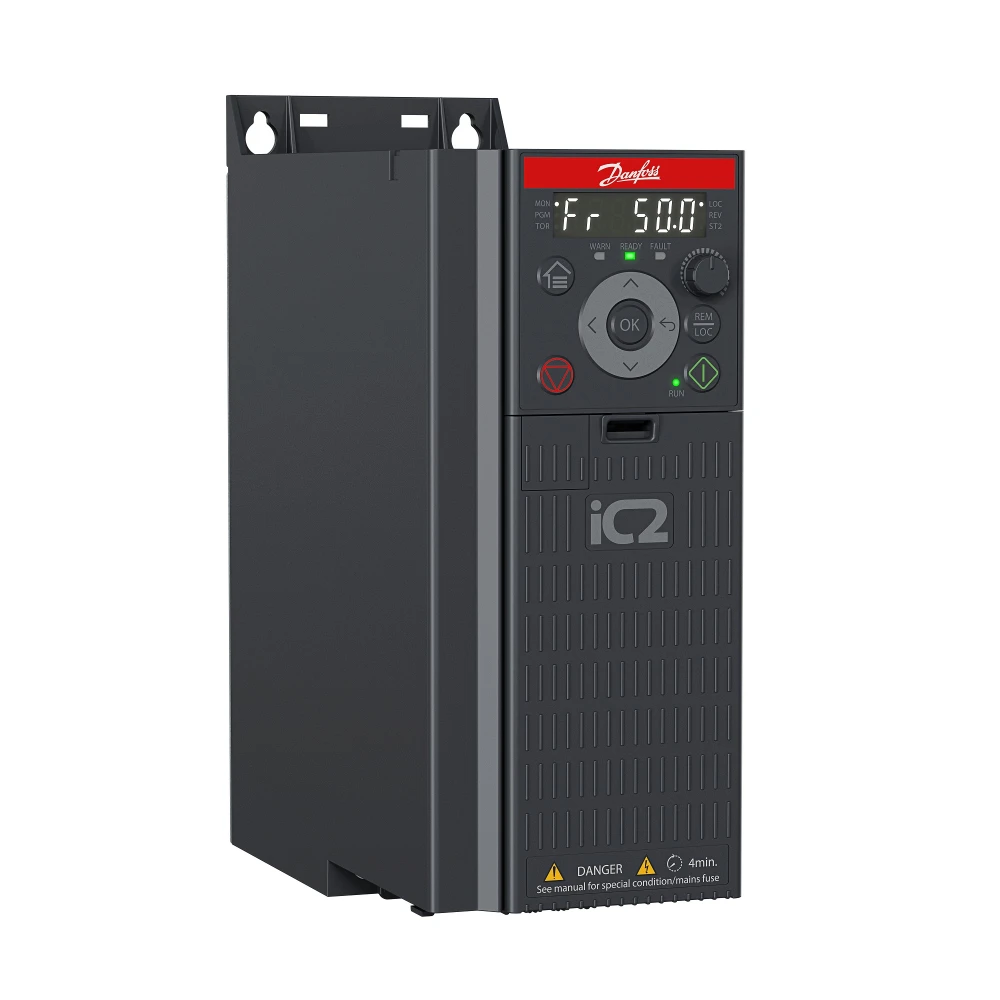
Sorry: This is a reference image; the model delivered may differ in design.

Danfoss iC2-Micro 7.5 kW C2

Price:

€ 1.141,00€ 1.380,61 Excluding VATincl. VAT

Log in or become a customer

Prices depend on your account and arrangements.
Log in to view your personal price and stock.

Art. No.

132L6135

Category

Requesting setup service

I would like to use the setup service (75 euros per drive). After completing the order, you will receive an email from us with which you can provide us with the details of your configuration.

Qty

Related products

Documentation

Here you will find all the important information for using and maintaining the product correctly. Download the appropriate documents and always work with the most up-to-date data.

Features

Technical specifications

Brand

Type

Voltage

EMC filter type

Phases

Breakchopper

RFI/EMC Filter

Series

Power

Description

The Danfoss iC2-Micro is the successor to the VLT® Micro Drive FC 51, combining compactness, flexibility and high performance in a single package. The drive offers excellent motor control for induction and permanent magnet motors (IPM/SPM), a built-in PID controller, a brake chopper (depending on the configuration), an integrated RFI filter and intelligent cooling. It operates reliably at ambient temperatures of up to 50 °C at full load. Standard features include RS485/Modbus communication, an RJ45 port, coated circuit boards and a 6-digit LED display. Suitable for pumps, fans, conveyor belts, mixers, packaging machines and palletising machines.

Applications

This product is used in various sectors and applications. Below you can see in which environments this drive is most commonly used. Select an application to find the right implementation and related products directly.

Technical support?

Do you need help with using, installing, or maintaining this product? Our specialists are ready to provide practical advice and immediate support. Whether it’s a question, a malfunction, or an application: you’ll quickly connect with someone who shares your concerns.

View the documentation or contact us directly for personal support.

Frequently asked questions

The answers to the most frequently asked questions about this product.
Quick and clear, so you can get straight on with it.

What is the difference between a worm gearbox and a helical gearbox?

A worm gearbox offers high gear ratios in a compact design and is self-locking when stationary, making it ideal for applications where the load must not move backwards. A gear gearbox (such as a helical or planetary gearbox) provides higher mechanical efficiency and is suitable for higher power ratings and continuous heavy-duty operation.

Can I combine a gearbox with any electric motor?

Not always without adaptation. The connection between the motor and the gearbox must be mechanically compatible in terms of flange (IEC standard) and shaft diameter. Jumatra supplies motor-gearbox combinations as fully assembled kits, ensuring that the dimensions and mounting are correct.

What type of lubrication is required, and how often should I perform maintenance?

Worm gearboxes are typically filled with mineral or synthetic oil. Synthetic oil offers longer lubrication intervals and is better suited for extreme temperatures. Check the oil level periodically and change the oil according to the manufacturer's maintenance schedule, typically after the first 500 operating hours and then annually or every 3,000 operating hours.

Which mounting type is possible and does this affect the lubrication?

Most reducers are available in multiple mounting positions (horizontal, vertical, hanging). The mounting position directly affects the oil level and the lubrication of the internal gears. In case of a different mounting position, the oil level must be adjusted or an adapted version must be supplied. Always mention the desired mounting position in your request.

How do I calculate the required transfer ratio?

The transmission ratio = input speed ÷ desired output speed. For example, if you have a motor with a speed of 1450 rpm and you want an output speed of 50 rpm, you need a ratio of 1:29. Also take into account the required output torque and the thermal allowable power of the reducer.

What is the maximum torque and how do I determine it?

The maximum torque (Nm) is listed in the technical specifications of the gearbox. Ensure that the required operating torque, including starting torques, remains well below the nominal torque of the gearbox. In case of doubt, we recommend based on your process data.

How quickly can you deliver, and do you also offer installation and commissioning services?

We stock a wide range of standard gearboxes, typically available for delivery within 1–3 working days. Express delivery is also available. Please contact us for current availability. If required, Jumatra also provides on-site mechanical installation and commissioning, including alignment and an initial oil fill check.

Can you provide a complete, ready-to-use drive system?

Yes. Jumatra not only supplies individual components, but also provides complete drive systems, ready for installation. This means: the motor is mounted on the gearbox, the drive is fully configured and parameterized for your application, and the cable assembly is custom-assembled and connected. You receive a system that you can immediately put into operation without additional on-site assembly or adjustment work. One point of contact for the entire system.

Account
WISHLIST
WISHLIST
Login
Password Recovery

Lost your password? Please enter your username or email address. You will receive a link to create a new password via email.

Danfoss iC2-Micro 7.5 kW C2

€ 1.141,00€ 1.380,61 Excluding VATincl. VAT
Qty
Shopping cart 0
RECENTLY VIEWED 0

Requesting a quote from Jumatra

Requesting quotes for your materials? You can request a quote in two ways:

  1. Offer based on your shopping cart
    Add the desired products to your shopping cart and proceed through the ordering process. Fill in your details and shipping information. In the final step, choose Request a quote instead of ordering directly.

  2. Request a quote free of obligation via the form
    Don't have a concrete product selection yet or would you like to discuss installation or custom-made solutions first? Then fill out the quote form. We will then contact you.

Explanation: RPM

RPM stands for Revolutions Per Minute, that is to say, the number Revolutions that a electric motor per minute makes. In Dutch, this is also called the rotational speed.

The RPM indicates How quickly the as of the electric motor turns. For example, an engine with a speed of 1500 RPM makes approximately 1500 complete revolutions per minute.

The speed of an electric motor is mainly determined by the number Poland and the net frequency. With a standard mains frequency of 50 Hz, the most common rotational speeds are approximately:

2-pole: 3000 RPM
4-pole: 1500 RPM
6-pole: 1000 RPM
8-pole: 750 RPM

In practice, the actual engine speed is slightly lower due to slippage in the engine. That’s why you often see values like 2850 RPM, 1450 RPM, 960 RPM, or 710 RPM on type plates.

The correct RPM is important because each application has its own requirements. specific turning speed required. Pumps, fans, conveyor belts and machines operate optimally within a determined gear range. A too high speed can lead to excessive wear or incorrect operation, while a low engine speed insufficient capacity or can generate power.

In short, RPM indicates How quickly one electric motor turns and is one of the most important specifications when choosing the right electric motor for a particular application.

Explanation: Material

It material of an electric motor largely determines the strength, durability and heat dissipation of the motor. The housing of electric motors is usually made of cast iron or aluminum.

Engines with a cast iron housing It is extra strong, vibration-resistant, and suitable for Heavy industrial applications. This type of motor is often used in environments where reliability and robustness are essential.

Engines with a aluminum housing on the contrary, he is lighter of weight and have a good heat dissipation. This makes them suitable for applications where a compact and Efficient solution is desired.

In short, the material of the housing determines how well the motor works. file is against tax, environment and temperature, and which applications are most suitable.

Explanation: Poland

It number of poles of an electric motor determines how fast the motor rotates and how much force (torque) This delivers power. In the motor, a magnetic field is generated with multiple north and south poles. How more poles the motor has, how It's going slower now.

At a standard network frequency of 50 Hz Does this mean that a 2-pole motor approximately 3000 revolutions per minute creates, while a 4-pole motor around the 1500 rpm turns and a 8-pole motor approximately 1000 rpm achieves.

In addition to speed, the number of poles also has an effect on couple. Engines with more poles deliver more power strength and are suitable for applications where lower speed and higher torque are desired. Motors with fewer poles rotate faster and are often used in situations where speed It is more important than strength.

In short, it determines Number of poles balances the speed and power of the electric motor.

Explanation: Building form

The building form indicates from an electric motor How the motor is mounted becomes and in which position it can be placed. This determines how the motor is installed in an installation.

Common building forms include, for example B3, B5 and B35/B14. One B3 The motor has feet and is mounted on a flat surface. One B5 The motor has a flange on the front, which allows the motor to be connected directly to a machine. B35 The motor combines both, so feet and a flange, This provides additional flexibility during installation.

Choosing the correct configuration is important to ensure that the motor fits correctly into the application and stable assembled can be.

In short, the configuration determines how and where the electric motor is mounted and used within an installation.

Explanation: Phases

The number phases indicates on which electric motor Electrical connection the motor works. The most common variants are 1-phase and 3-phase motorcycles.

One 1-phase motor Works on a standard 230V connection and is mainly used in smaller applications, such as household appliances or light machines. These motors are easy to connect, but generally provide less power and torque.

One 3-phase motor works on a 400V Power current connection and is used for heavier and industrial Applications. These motors run more efficiently, deliver higher and more consistent torque and have better performance when used over long periods.

Sometimes it is also mentioned 2-phases, However, this hardly ever happens in practice. Usually, this involves a 1-phase motor with an additional winding (capacitor) or the use of two phases within a 3-phase connection.

In short, the number of phases determines the power, efficiency and application possibilities of the electric motor.

Explanation: Power

When we talk about the power of an electric motor We mean the amount of power that the engine can deliver. We usually express that in kilowatt (kW) or in horsepower (HP or pk). Kilowatt is the modern metric unit that is mainly used in Europe. Horsepower is an older term that you still often see, for example in cars or American machines.

One kilowatt equals 1000 watts, And if you convert that to horsepower, then 1 kW corresponds to about 1.34 hp. Conversely, 1 hp is approximately 0.75 kW. So a 2 kW motor produces about 2.7 hp of power. The higher the power, the more powerful the engine is. A 5 kW motor can therefore handle heavier tasks than a 2 kW motor.

In practice, this means that an electric bike, for example, has an engine of about 0.25 kW, which is enough to support someone smoothly while cycling. An electric car like a Tesla, on the other hand, often has an engine of more than 150 kW, which allows for high speeds and rapid acceleration.

In short: kW and hp are two ways of measuring the same thing: the amount of power an electric motor produces. If you want to know what power you need, it depends on what you want to drive with it.