VAT.
on / off

Free advice

Can't you figure it out? Our specialists are happy to help you find the right products.

Report a problem?

Having a problem? Our specialist will be there immediately, 24/7.

Electric motor speed: What RPM do you need?

The correct rotational speed of a electric motor starts with the speed your machine needs. Then you determine which transmission and what torque are needed to drive that machine. Therefore, simply comparing the power in kW is insufficient.

On the type plate and in our shop you will find the motor speed as RPM: Revolutions Per Minute. But what does the difference between, for example, 1500 and 3000 RPM mean for your drive system? And when should you choose a different engine speed, a frequency drive or a reducer? In this article we explain how to make that choice.

How do you determine the correct speed of an electric motor?

First determine how fast the driven shaft should rotate. With a direct coupling, it rotates at the same speed as the motor shaft. With a reducer, belt or chain transmission, those speeds can vary. Then you look at the load. The motor must provide sufficient torque to get the machine started and keep it running. Starting a loaded transport belt, for example, places different requirements than starting an unloaded drive.

Three questions are decisive for the selection:

  • What motor speed or speed range does the machine need?
  • What transmission is between the motor and the driven shaft?
  • How many pairs are needed when starting up and during normal operation?

If you replace an existing motor and the application remains the same, the type plate and the data from the existing transmission form the basis. For a new drive system, you use the machine data or calculations from the machine manufacturer.

What is the difference between 750, 1000, 1500 and 3000 RPM?

At standard asynchronous electric motors You often encounter speed ratings of 750, 1000, 1500 and 3000 rpm. These values correspond to the speed of the magnetic rotor at 50 Hz. The nominal speed of the motor shaft is slightly lower.

Number of polesSynchronous rotational speed at 50 HzExample nominal rotational speed
2-polygons3000 RPM2900 RPM
4-polygons1500 RPM1450 RPM
6-polygons1000 RPM960 RPM
8-polygons750 RPM720 RPM

The nominal speeds are examples. The exact value can be found on the type plate and in the product specifications.

How do the number of poles and the frequency determine the rotational speed?

At the same feed frequency, a higher number of poles means a lower synchronous speed. A 2-pole electric motor At 50 Hz, it has a synchronous rotational speed of 3000 RPM; a 4-pole version reaches 1500 RPM. If you want to change the speed of a suitable motor during use, a frequency regulator can adjust the frequency offered. The number of poles of a standard motor remains unchanged in this case.

Why is there, for example, 1450 RPM on the type plate?

In an asynchronous motor, the rotor rotates at slightly slower speeds during normal operation than the magnetic rotating field. This difference is called slip and is necessary to deliver torque. Therefore, a 1500-rpm motor can have a typeplate value of 1450 RPM have. That nominal value corresponds to the nominal tax and the specified feeding conditions. With a different tax, the actual rotational speed may change slightly.

A difference between 1500 rpm in the general indication and 1450 RPM on the type plate does not therefore indicate a defect. For a precise comparison, use the nominal product specifications.

Which gear ratio suits your application?

The machine type alone does not determine which motor speed is suitable. In the applications below, you can see which data determines the choice.

Pumps and fans

In the case of centrifugal pumps and fans, the speed affects the capacity, pressure build-up and required power. A higher speed can therefore mean a significantly heavier load on the motor. If you want to increase the output, check the pump or fan characteristics and the power required at the new working point. Also check the maximum allowed speed. Mounting a faster motor without assessing these data can overload the drive.

Conveyor belts

On a conveyor belt, the desired belt speed and the diameter of the drive roller determine the required roller rotation speed. A larger drive roller moves more belt per revolution and therefore needs to rotate less quickly to achieve the same belt speed. A reducer then returns the motor speed to that value. If the belt speed needs to be variable, a frequency drive can be added.

Mengers and stirrups

In a mixer, the speed and torque must match the product, the stirring action, and the filling of the mixing tank. For example, a slow-turning stirrer may require a lot of torque to mix a tough mass. A reducer then reduces the motor speed and increases the available torque at the mixing shaft. Also consider starting a filled mixer. If different mixing speeds are required, a frequency drive can make the drive controllable.

Installation by Jumatra

Have the installation carried out by Jumatra. We will contact you after ordering to schedule the installation. The final price will be calculated afterwards based on a daily calculation per part.

How are motor speed, power and torque related?

The RPM tells you how fast the motor shaft rotates. The torque indicates how much torque the motor delivers. To assess whether a motor can drive your machine, you need both: the right speed and sufficient power. At the same power level, a motor with a lower nominal RPM produces more nominal torque. You can see this in these two motors:

PowerRotation speedCouples
1.5 kW1450 RPMApproximately 9.9 Nm
1.5 kW2900 RPMApproximately 4.9 Nm

The 1450 RPM motor provides about twice as much torque, while the other motor rotates twice as fast. A motor with the same number of kW but a different speed is therefore not automatically a suitable replacement.

This comparison applies to the declared electric motor operating values. Running an existing motor more slowly with a frequency drive Does not automatically provide more torque. It must also be checked separately whether the motor is providing sufficient power to start the machine.

How do you calculate the speed of an electric motor?

The speed can be calculated using the frequency and the number of poles. If there is a reduction gear between the motor and the machine, you can also calculate how fast the output shaft rotates.

Calculating speed with frequency and pooltal

The formula is: Synchronous rotational speed (RPM) = 120 × frequency (Hz) ÷ number of poles

A 4-pole motor For example, at 50 Hz, the synchronous speed is 120 × 50 ÷ 4 = 1500 RPM.

This is the speed of the magnetic rotor. In an asynchronous motor, the rotor shaft rotates slightly slower due to slip. Therefore, use the value on the typeplate if you need the nominal motor speed, for example 1450 RPM.

Calculating the rotational speed after a reducer

A reducer reduces the speed at which the machine is driven. At a ratio of 20:1, the motor shaft makes twenty revolutions for every revolution of the output shaft.

The formula is: Output speed = motor speed ÷ reduction ratio

With a motor running at 1450 RPM and a reduction ratio of 20:1, that becomes 1450 ÷ 20 = 72.5 RPM. The output shaft then rotates 72.5 times per minute.

How can you control the speed of an electric motor?

You can adjust the speed of your drive with a frequency drive, a reducer, or a combination of both. A frequency drive changes the RPM of the motor itself. A reducer reduces the speed at the machine side.

Regulate the speed with a frequency drive

A frequency drive adjusts the frequency and voltage to the motor so that you can adjust the rotational speed to the process. Think of a conveyor belt that needs to run faster or slower. Choose the drive based on the available power supply, the nominal motor current, and the required overload capacity. Also check whether the motor is suitable for use with a frequency drive.

Lowering the motor speed with a reducer

A reducer reduces the speed at the machine side and increases the available torque. This is suitable for machines that need to run slowly and require a lot of torque. There is no additional power generated: the lower speed allows for higher torque, with some of the power being lost. As a result, the output power is slightly lower than the input power.

Combining a frequency drive and a reducer

A combination is suitable when both deceleration and variable speed are required. The reducer brings the speed into the range of the machine; the frequency drive allows the speed within that range to be adjusted. In this way, a motor for a slow rotating mixer does not have to reach the desired machine speed solely through a very low frequency.

Frequency drive setup service

Have your frequency drive set up by the specialists at Jumatra. This way you can install the drive directly on your system.

How far can you increase or decrease the speed?

There is no fixed minimum or maximum speed that applies to every electric motor. The allowable range depends on the motor, cooling, load, and the machine being driven. WEG For example, for the W22 electric motors In the technical documentation, it is stated how much torque is allowed at different speeds. When running at a low speed for a long time, a lower load or independent ventilation may be necessary to prevent overheating. Additionally, for higher speeds, maximum mechanical speeds apply. Therefore, for your specific motor configuration, you must check both the allowed load and the maximum speed.

Can you replace an electric motor with another speed?

Yes, but only if the new speed and the available torque match the machine and the transmission. 1500-RPM motor replaced by a 3000-RPM version is not an equivalent exchange.

With the same feed frequency and transmission, the machine would run about twice as fast, provided the motor can handle the load. At the same nominal power, the faster motor provides about half of the nominal torque. At the same time, the machine may require more power at that higher speed. In our article about replacing an electric motor, you can read which specifications you need to check for that purpose.

Replacing the electric motor with a Jumatra

Do you want one? Replacing the electric motor Should you adjust the speed of your drive system? Send us a clear photo of the typeplate and specify what drives the motor. Also provide the data of any available reducer or frequency drive and tell us the speed you want to achieve. This way we can provide targeted advice on a suitable combination. Send your request via our contact page and we will help you immediately.

Frequently asked questions about the speed of an electric motor

How do you measure the electric motor speed when the type plate is illegible?
With a suitable speed meter, for example a contactless optical meter, you can measure the actual rotational speed. Use a safe measuring setup for this purpose. The result applies to the load and power during the measurement. You measure the rotational speed at the current load and power conditions. The measured value is therefore not automatically the nominal rotational speed of the motor.

With a suitable speed meter, for example a contactless optical meter, you can measure the actual rotational speed. Use a safe measuring setup for this purpose. The result applies to the load and power during the measurement. You measure the rotational speed at the current load and power conditions. The measured value is therefore not automatically the nominal rotational speed of the motor.

That depends on the motor type. A frequency drive with a 230V single-phase power supply Often has a three-phase output for a suitable three-phase motor. This is not automatically suitable for a single-phase capacitor motor. There are special controllers for certain single-phase motors, for example versions with a permanent operating capacitor. The manufacturer must support the combination. Therefore, check the motor type and the input and output specifications of the controller; only the indication ‘230V’ is insufficient.

We will help you further.

Our team of specialists is at your disposal with expert advice, technical support and quick assistance in case of breakdowns. 24 hours a day, 7 days a week, help when you need it.

Account
WISHLIST
WISHLIST
Login
Password Recovery

Lost your password? Please enter your username or email address. You will receive a link to create a new password via email.

Shopping cart 0
RECENTLY VIEWED 0

Explanation: Power

When we talk about the power of an electric motor We mean the amount of power that the engine can deliver. We usually express that in kilowatt (kW) or in horsepower (HP or pk). Kilowatt is the modern metric unit that is mainly used in Europe. Horsepower is an older term that you still often see, for example in cars or American machines.

One kilowatt equals 1000 watts, And if you convert that to horsepower, then 1 kW corresponds to about 1.34 hp. Conversely, 1 hp is approximately 0.75 kW. So a 2 kW motor produces about 2.7 hp of power. The higher the power, the more powerful the engine is. A 5 kW motor can therefore handle heavier tasks than a 2 kW motor.

In practice, this means that an electric bike, for example, has an engine of about 0.25 kW, which is enough to support someone smoothly while cycling. An electric car like a Tesla, on the other hand, often has an engine of more than 150 kW, which allows for high speeds and rapid acceleration.

In short: kW and hp are two ways of measuring the same thing: the amount of power an electric motor produces. If you want to know what power you need, it depends on what you want to drive with it.

Explanation: RPM

RPM stands for Revolutions Per Minute, that is to say, the number Revolutions that a electric motor per minute makes. In Dutch, this is also called the rotational speed.

The RPM indicates How quickly the as of the electric motor turns. For example, an engine with a speed of 1500 RPM makes approximately 1500 complete revolutions per minute.

The speed of an electric motor is mainly determined by the number Poland and the net frequency. With a standard mains frequency of 50 Hz, the most common rotational speeds are approximately:

2-pole: 3000 RPM
4-pole: 1500 RPM
6-pole: 1000 RPM
8-pole: 750 RPM

In practice, the actual engine speed is slightly lower due to slippage in the engine. That’s why you often see values like 2850 RPM, 1450 RPM, 960 RPM, or 710 RPM on type plates.

The correct RPM is important because each application has its own requirements. specific turning speed required. Pumps, fans, conveyor belts and machines operate optimally within a determined gear range. A too high speed can lead to excessive wear or incorrect operation, while a low engine speed insufficient capacity or can generate power.

In short, RPM indicates How quickly one electric motor turns and is one of the most important specifications when choosing the right electric motor for a particular application.

Explanation: Material

It material of an electric motor largely determines the strength, durability and heat dissipation of the motor. The housing of electric motors is usually made of cast iron or aluminum.

Engines with a cast iron housing It is extra strong, vibration-resistant, and suitable for Heavy industrial applications. This type of motor is often used in environments where reliability and robustness are essential.

Engines with a aluminum housing on the contrary, he is lighter of weight and have a good heat dissipation. This makes them suitable for applications where a compact and Efficient solution is desired.

In short, the material of the housing determines how well the motor works. file is against tax, environment and temperature, and which applications are most suitable.

Explanation: Phases

The number phases indicates on which electric motor Electrical connection the motor works. The most common variants are 1-phase and 3-phase motorcycles.

A 1-phase motor Works on a standard 230V connection and is mainly used in smaller applications, such as household appliances or light machines. These motors are easy to connect, but generally provide less power and torque.

A 3-phase motor works on a 400V Power current connection and is used for heavier and industrial Applications. These motors run more efficiently, deliver higher and more consistent torque and have better performance when used over long periods.

Sometimes it is also mentioned 2-phases, However, this hardly ever happens in practice. Usually, this involves a 1-phase motor with an additional winding (capacitor) or the use of two phases within a 3-phase connection.

In short, the number of phases determines the power, efficiency and application possibilities of the electric motor.

Explanation: Building form

The building form indicates from an electric motor How the motor is mounted becomes and in which position it can be placed. This determines how the motor is installed in an installation.

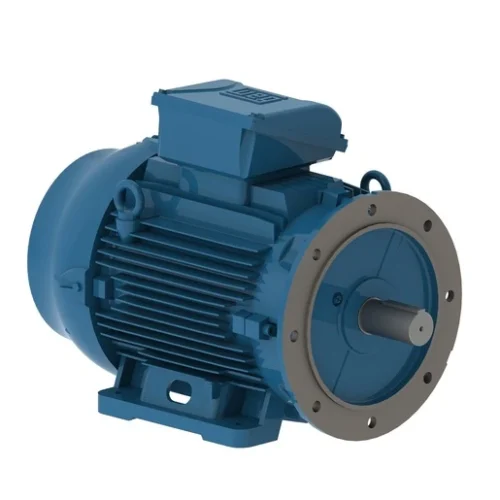
Common building forms include, for example B3, B5 and B35/B14. One B3 The motor has feet and is mounted on a flat surface. One B5 The motor has a flange on the front, which allows the motor to be connected directly to a machine. B35 The motor combines both, so feet and a flange, This provides additional flexibility during installation.

Choosing the correct configuration is important to ensure that the motor fits correctly into the application and stable assembled can be.

In short, the configuration determines how and where the electric motor is mounted and used within an installation.

Requesting a quote from Jumatra

Requesting quotes for your materials? You can request a quote in two ways:

  1. Offer based on your shopping cart
    Add the desired products to your shopping cart and proceed through the ordering process. Fill in your details and shipping information. In the final step, choose Request a quote instead of ordering directly.

  2. Request a quote free of obligation via the form
    Don't have a concrete product selection yet or would you like to discuss installation or custom-made solutions first? Then fill out the quote form. We will then contact you.

Explanation: Poland

It number of poles of an electric motor determines how fast the motor rotates and how much force (torque) This delivers power. In the motor, a magnetic field is generated with multiple north and south poles. How more poles the motor has, how It's going slower now.

At a standard network frequency of 50 Hz Does this mean that a 2-pole motor approximately 3000 revolutions per minute creates, while a 4-pole motor around the 1500 rpm turns and a 8-pole motor approximately 1000 rpm achieves.

In addition to speed, the number of poles also has an effect on couple. Engines with more poles deliver more power strength and are suitable for applications where lower speed and higher torque are desired. Motors with fewer poles rotate faster and are often used in situations where speed It is more important than strength.

In short, it determines Number of poles balances the speed and power of the electric motor.